The Raptor Law of AI Agents: Why Every Model Eats Yesterday's Harness

In From Silicon to Symphony, I argued that multi-agent software patterns are migrating downward into silicon. A faster cycle hits your stack first: every frontier model eats the harness you built for its predecessor.
In From Silicon to Symphony, I mapped the spatial anatomy of multi-agent systems. Five coordination invariants (memory management, dependency resolution, state coherence, fault recovery, and resource scaling) force agent frameworks, orchestras, and CPUs to converge on identical architectures. I closed that essay with a hardware forecast: with NVIDIA's BlueField-4 DPUs, NVLink 6, and Microsoft's Maia 200 ASICs, orchestration primitives written in Python today will move into silicon within two to three years.
That forecast left a faster, more uncomfortable engineering problem open on the time axis. Long before custom silicon absorbs your orchestrator, every six-month frontier model release absorbs another layer of your application stack.
Walk through any production AI team in late 2026 and you can feel the whiplash. On one side, harness engineering has turned into its own discipline, with 21,500 new agent-harness repositories created on GitHub in 2026 alone. On the other side, teams running serious evaluations are deleting tens of thousands of lines of custom scaffolding and watching their agents get faster, cheaper, and more accurate the day the code comes off.
If you have ever spent three weeks building a validation loop, a 20-tool action menu, or a multi-stage sprint runner only to watch a new model turn it into dead weight, you have collided with a structural law of systems engineering. Rocket propulsion engineers have a name for the dead weight, and a photograph that shows where it goes.
The Hidden Number in the Raptor Photograph
You have seen the side-by-side photograph of SpaceX's Raptor 1, Raptor 2, and Raptor 3 engines. Raptor 1 looks like an explosion in a plumbing warehouse, covered in looping tubes, bolted flanges, and dozens of external sensors. Raptor 2 tightens the routing. Raptor 3 looks like a cast-metal column with almost nothing hanging off the exterior.
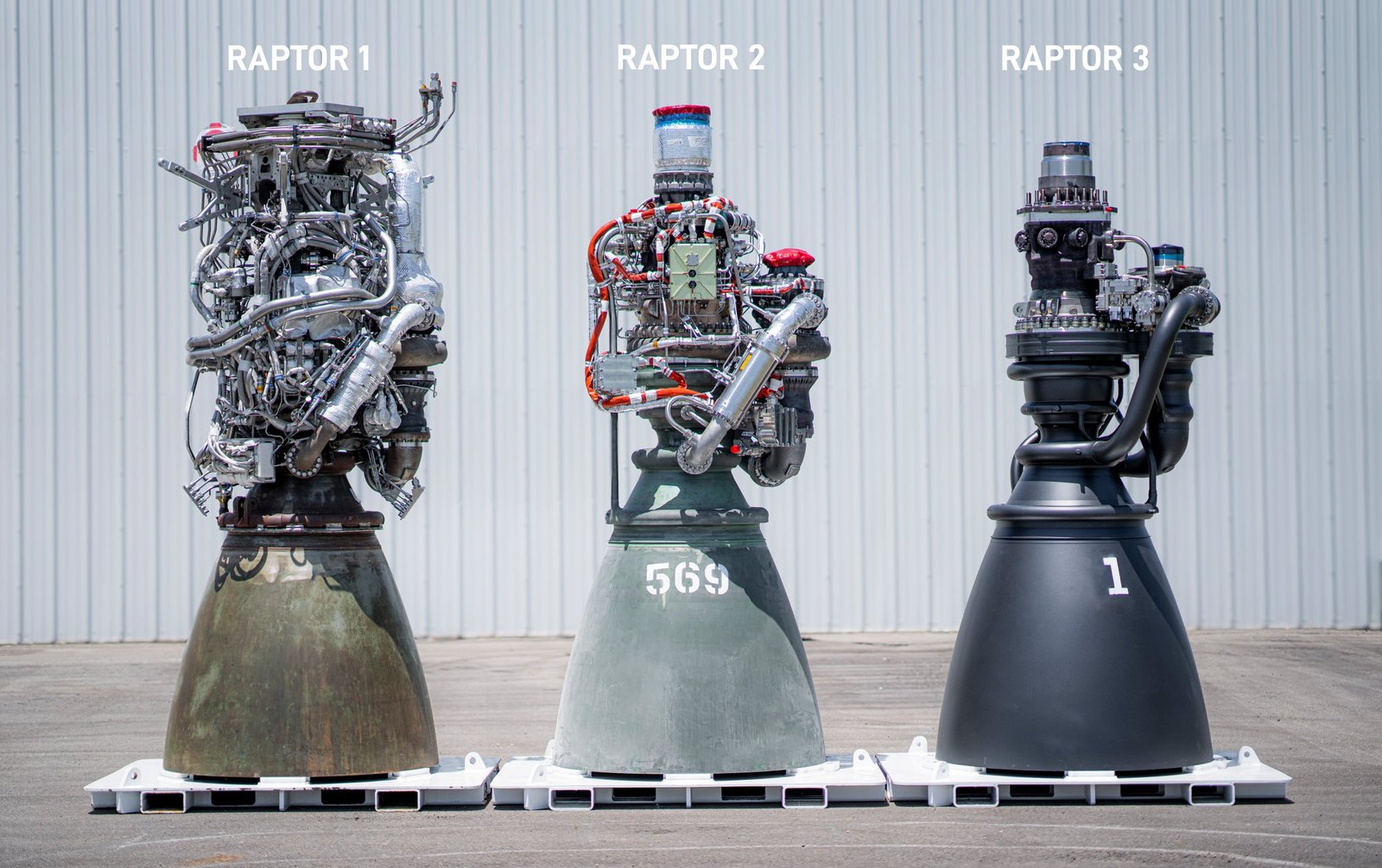
SpaceX's sea-level Raptor 1, Raptor 2, and Raptor 3 engines side by side, showing five years of external plumbing and sensor absorption (Photo: SpaceX).
Casual commentary misreads what changed between those three engines. As Construction Physics analyst Brian Potter detailed in his September 2026 teardown, the core propulsion architecture stayed constant from Version 1 through Version 3. All three generations run the same full-flow staged combustion (FFSC) cycle, burning subcooled liquid methane and liquid oxygen at roughly a 3.6:1 oxidizer-to-fuel ratio through two turbopumps and regenerative wall cooling.
The change happened in the hardware bolted around the engine.
When SpaceX published Raptor 3's sea-level comparison sheet in August 2024, headlines focused on thrust climbing from 185 to 280 metric tons-force (tf). The decisive row sat directly beneath dry engine mass: engine plus vehicle-side commodities and hardware mass. Elon Musk calls the gap between dry engine mass and installed mass induced mass, meaning mass required by an engine design that sits outside the engine itself. Subtract dry mass from installed mass across all three generations, and you isolate the physical equivalent of an AI agent harness.
| Sea-Level Metric | Raptor 1 (2019-21) | Raptor 2 (2022-25) | Raptor 3 (2026) |
|---|---|---|---|
| Sea-Level Thrust | 185 tf | 230 tf | 250 tf flight (280 tf spec) |
| Chamber Pressure | ~250-253 bar | ~300 bar | ~330 bar (350 bar peak) |
| Engine Dry Mass | 2,080 kg | 1,630 kg | 1,525 kg |
| External Hardware ("Harness") | 1,550 kg (42.7%) | 1,245 kg (43.3%) | 195 kg (11.3%) |
| Total Installed Mass | 3,630 kg | 2,875 kg | 1,720 kg |
| Installed System TWR | 51.0 | 80.0 | 145.4 flight (162.8 spec) |
(Note on propellant accounting: SpaceX's table lists 350 s vacuum specific impulse for the sea-level nozzle; atmospheric sea-level Isp sits near 330 s on Raptor 1 and 3 and 327 s on Raptor 2. Separating Raptor 3's 250 tf flight rating on 2026 Starship V3 vehicles from its 280 tf test-stand spec avoids the benchmark inflation common on AI leaderboards.)
Do the subtraction. From Raptor 1 to Raptor 3, SpaceX shaved 555 kg off the engine itself (-26.7%) while deleting 1,355 kg per engine of surrounding vehicle-side hardware (-87.4%). Over 70% of all mass saved across the program came from stripping external scaffolding.
Between Raptor 2 and Raptor 3, the ratio gets even sharper. Core engine dry mass fell by only 105 kg (1,630 kg to 1,525 kg), while external hardware dropped by 1,050 kg (1,245 kg to 195 kg). 90.9% of Raptor 3's mass advantage over Raptor 2 came from absorbing surrounding scaffolding. Across Super Heavy's 33 booster engines, deleting stainless-steel heat shrouds, CO2 fire suppression hardware, and secondary distribution plumbing cut 34.65 metric tonnes of induced mass relative to Raptor 2, and 44.72 metric tonnes relative to Raptor 1.
SpaceX earned that deletion through five concrete engineering steps. Raptor 1 flew blanketed in external temperature and pressure sensors so engineers could map unknown thermal and acoustic regimes; once the envelope was characterized, SpaceX stripped most sensors and buried the survivors inside internal thermal protection. Raptor 2 retired main-chamber spark igniters (because hot fuel-rich and oxygen-rich preburner gases auto-ignite on contact) and removed wasteful throat film cooling. Engineers consolidated scattered valves into unified valve plates, centralized controllers, and replaced leak-prone bolted flanges with welded joints. On Raptor 3, secondary pipes that once wrapped around the exterior moved inside metal walls produced via custom 3D metal printing, paired with regenerative cooling across exposed surfaces. With no fragile external plumbing left exposed, Raptor 3 dropped individual engine heat shields and CO2 fire suppression altogether, bundling nitrogen spin-up lines into a single umbilical in place of helium.
Two aerospace constraints keep this parallel honest.
First, you cannot skip Raptor 1. On September 16, 2026, responding to comparisons between Raptor 3 and Space Pioneer's Tianhuo-21 methane engine, Musk warned rocket startups against copying the final exterior directly:
"I would recommend against a new company trying to make Raptor 3. While it appears simple on the outside (necessary to survive extreme heat without a heat shield), the inside has very complex geometry that can only be manufactured using highly modified 3D metal printing."
Raptor 1's external spaghetti served as the measurement rig required to build Raptor 3. Exposed sensors and bolted flanges let engineers observe failure modes on the stand and unbolt damaged assemblies after hot-fire tests.
Second, complexity migrates inward and sends you an invoice in inspectability. Welding flanges shut and printing internal flow channels improves installed thrust-to-weight while sacrificing component-level field repair: technicians swap whole engines or cut metal rather than unbolting a manifold, and fewer sensors mean narrower visibility into internal state.
That is the Raptor Law: each generation internalizes the load-bearing scaffolding that its predecessor required externally, collapsing induced overhead, trading away low-level inspectability, and pushing the harness boundary outward to a new, irreducible frontier.
Six Waves of AI Harness Absorption (2023-2026)
Software engineers named the outer layer late. Industry vocabulary moved from prompt engineering in 2023, to context engineering in 2025, to harness engineering in February 2026. On February 5, 2026, Mitchell Hashimoto defined the practice in his AI adoption notes: "Anytime you find an agent makes a mistake, you take the time to engineer a solution such that the agent never makes that mistake again." Six days later, OpenAI's Ryan Lopopolo published the Codex team's field report and popularized the formula Agent = Model + Harness.
Just like Raptor's combustion cycle, the Transformer architecture stayed recognizable from 2023 through late 2026 while six layers of external scaffolding migrated into neural weights and native runtimes.
| Domain | Gen N Harness | Gen N+1 Core | Measured Shift |
|---|---|---|---|
| 1. Structured I/O | Regex parsers, retry loops, JSON prompt templates | Constrained decoding + schema-trained weights | Complex schema adherence rose from <40% (gpt-4-0613) to 100% (gpt-4o) |
| 2. Reasoning | External CoT/ToT wrappers, PRMs, MCTS search | Outcome RLVR + native test-time reasoning | DeepSeek-R1-Zero rose 15.6% to 71.0% on AIME 2024; PRMs/MCTS retired |
| 3. Code Retrieval | Chunking heuristics, embeddings, local vector DBs | Agentic search (glob, ripgrep) + repo maps | Claude Code dropped vector DBs with zero staleness (Cursor noted +12.5% hybrid lift) |
| 4. Tool Interfaces | Custom ACIs, 17-29 action menus, upfront MCP schemas | Minimal bash/Python REPL + raw protocols (CDP) | Browser Use 1.0: +14-33 pts at 2.7x-5.2x lower cost; MCP Code Exec: -98.7% tokens |
| 5. Long Horizon | Forced session resets, feature-by-feature sprints | Native coherence + SDK context compaction | Anthropic dropped resets (Opus 4.5) and sprints (Opus 4.6), -37.6% build cost |
| 6. Agent Memory | Prompt steering, rigid failure-only logging rules | Autonomous closed-loop memory verification | Opus 5/5.5 reached 0.828-0.838 natively on CL-Bench 1.0; rigid rules cut -0.234 |
Three engineering arcs show how fast yesterday's indispensable wrapper turns into drag.
Princeton's SWE-agent to mini-SWE-agent
In May 2024, Princeton's SWE-agent paper showed that GPT-4 Turbo struggled inside a raw Linux shell. Wrapping the model in a custom Agent-Computer Interface (a 100-line windowed file viewer, line-targeted editor, and syntax-checked autosave) raised full SWE-bench resolution from 3.8% to 12.5%, beating a raw-shell baseline by 10.7 percentage points in ablation.
Less than two years later, the same Princeton group shipped mini-SWE-agent: roughly 100 lines of Python executing stateless subprocess.run bash commands over a flat linear message history. On the February 2026 SWE-bench Verified bash-only leaderboard, that 100-line loop reached 76.8% with Claude 4.5 Opus ($0.75/task) and 72.8% with GPT-5.2, and in a September 2026 multi-harness evaluation scored 75.5%, matching or beating heavier native scaffolds. The 2024 custom ACI got GPT-4 off the pad, then turned redundant once post-trained models mastered standard Unix shells natively.
Vercel's d0 and Browser Use 1.0
In December 2025, Vercel engineer Andrew Qu stripped their internal text-to-SQL agent d0 from 17 specialized tools (GetEntityJoins, LoadCatalog, JoinPathFinder, SyntaxValidator) down to two primitives on Claude Opus 4.5: sandboxed bash over their Cube semantic files plus ExecuteSQL. Their published internal evaluation covered only five queries, so treat the sample size with appropriate caution, yet execution time dropped 3.5x (274.8 s to 77.4 s), token consumption fell 37%, and pass rate went from 4/5 to 5/5. Qu's post-mortem captures the Raptor 2-to-3 transition in two sentences:
"We were constraining reasoning because we didn't trust the model to reason. With Opus 4.5, that constraint became a liability."
Browser Use hit the same wall across a much larger production codebase. After two years of adding dedicated actions for web edge cases (peaking at 29 actions and 67,599 lines of Python), co-founder Gregor Zunic ran a 50-minute experiment exposing a persistent Python REPL and raw Chrome DevTools Protocol (cdp()) access. Execution traces showed the model ignored every indexed-DOM helper to write custom JavaScript selectors and raw CDP commands directly.
On November 10, 2026, Browser Use 1.0 deleted 136,905 lines across 554 files, collapsing 24 browser actions into a Python REPL tool and two completion methods. Across the 180 frozen tasks of BU Bench v2.1, tested models gained 14 to 33 points at 2.7x to 5.2x lower cost, even improvising recovery flows nobody had coded (calling Page.stopLoading and Network.setBlockedURLs on a hung exchange page, locating a JSONP endpoint, and pulling 4,720 rows in 3.5 minutes). Equally informative was the exception: a dedicated solver primitive still beat raw code 6-for-6 versus 0-for-3 where page scripts lacked low-level browser access. Zunic's design rule matches SpaceX's part-deletion filter: keep a helper only when the model cannot rewrite it after reading it once, and build a dedicated tool only when the agent lacks the underlying primitive.
How External Plumbing Enters the Weights
Harnesses migrate into subsequent models through a concrete post-training mechanism. As Philipp Schmid summarized in January 2026, "The Harness is the Dataset." Each generation's external scaffold serves as the Reinforcement Learning with Verifiable Rewards (RLVR) gym that trains its successor.
Published 2025-2026 training pipelines document every step of that loop. Meta FAIR's SWE-RL trained Llama-3.3-70B on GitHub pull-request evolution with rule-based rewards to reach 41.0% on SWE-bench Verified. Search-R1 placed a live search engine inside PPO and GRPO rollouts and applied retrieved-token loss masking so gradients updated strictly on model queries and reasoning rather than external documents, lifting Qwen2.5-7B by 26% to 41% over classic RAG baselines. Alibaba scaled long-horizon agent RL across 20,000 parallel containerized environments for Qwen3-Coder, and by February 2026 Qwen3-Coder-Next, an 80B Mixture-of-Experts model activating only 3B parameters per token, reached 70.6% to 71.3% on SWE-bench Verified and 42.7% on SWE-bench Pro. Moonshot AI's Kimi K2 harvested over 3,000 real MCP tools from GitHub and synthesized 20,000+ additional tools across simulated user rollouts. And an ICLR 2026 study demonstrated that a 3B-parameter Qwen2.5 model trained via asynchronous sandbox RL outperformed prompted Claude 3.5 Sonnet, Llama 3.1 405B, and GPT-4o running multi-day AIDE scaffolds on 8 of 12 MLE-Bench tasks.
That training loop is SpaceX's McGregor test stand expressed in gradient descent. Engineers wrap Generation N in an explicit external harness to capture verifiable execution traces, then optimize Generation N+1 against those exact traces until external Python scaffolding compiles into internal weight geometry.
The Empirical Paradox and Unmeasured Harness Rot
Read only the absorption studies and you end up as a Bitter Lesson purist. Rich Sutton argued in 2019 that general methods leveraging computation reliably beat hand-coded human domain rules, and in June 2026 Google DeepMind's Logan Kilpatrick gave that view a 2026 update ("Why the Model Eats the Harness"), estimating a 12-month shelf life for generic agent scaffolding.
Two independent academic evaluations published in September 2026 confirm that general coding models are overtaking specialized domain harnesses. At UC Berkeley and Stanford, What Happens When the Model Eats the Stack? compared general Codex agents (o3 through GPT-5.6 Sol) against human-engineered SQL and data-analysis scaffolds (Agentar-Scale-SQL on TAG-Bench and multi-agent DeepEye on DAB). Under o3, the specialized data scaffold won; under GPT-5.6 Sol, the general coding agent overtook it, gaining more than 35 percentage points on DAB, doubling output-token efficiency, and cutting average turns per query by 74.1% (23.2 down to 6.0). Weeks later, researchers at EPFL and Apple tested 17 harness-backbone pairs across 30 MLE-bench tasks and 6 pairs on 40 NatureBench tasks under equal time and GPU budgets, finding that a minimal single-session agent (Malena, equipped only with file read, file write, and bash) matched or beat every specialized ML-engineering scaffold.
Before you delete your repository on the strength of those two papers, examine what happens when you hold model weights strictly frozen and vary only the outer environment.
In February 2026, LangChain kept gpt-5.2-codex fixed on Terminal-Bench 2.0 and lifted deepagents-cli from 52.8% to 66.5% (+13.7 percentage points, moving from outside the Top 30 into the Top 5) through four targeted middleware additions: startup directory and binary discovery, pre-completion verification checklists, repetitive edit-loop breakers, and a "Reasoning Sandwich" (xhigh planning, high implementation, xhigh verification, after pure xhigh timed out at 53.9%).
That same month, OpenAI's Codex field report documented how three engineers (later seven) shipped roughly one million lines of production code across 1,500 merged pull requests with zero hand-written lines. Their leverage came from deterministic environment engineering: trimming AGENTS.md to a ~100-line index into docs/, enforcing a strict one-way dependency graph (Types -> Config -> Repo -> Service -> Runtime -> UI) via custom linters whose error messages carry inline remediation steps, and provisioning per-worktree Chrome DevTools and observability stacks.
Scale AI's 2026 SWE-bench Pro audits quantify the same spread across labs. Ninety-nine of 100 entries on public SWE-bench Verified trackers were self-reported, and OpenAI retired Verified in February 2026 after auditing flawed tests and patch memorization across 59.4% of inspected failing tasks. Holding weights constant on Gemini 3.1 Pro, scores dropped from 80.6% (Verified) to 54.2% (vendor Pro scaffold) to 46.1% on Scale's standardized SEAL Pro harness. On Scale's 276-task private commercial repository suite, every tested frontier model remained below 50% (47.1% for Claude Opus 4.6 thinking; 43.4% for GPT-5.4 xHigh).
Even Google DeepMind's podcast thesis carries an obvious product footnote. While warning startups that models eat harnesses, Google is building its own Antigravity harness across IDE, CLI, SDK, and browser surfaces. As practitioner Jihoon Jeong observed: "Decoded, 'the model eats the harness' means something more specific: our harness eats yours."
What reconciles massive deletion wins with 14-to-20-point harness gains is a third phenomenon measured across four 2026 empirical audits: unmeasured harness rot.
In July 2026, Queen's University researchers held the underlying LLM constant across 35 sequential releases of Qwen Code CLI on stratified SWE-bench tasks; token spend per task swelled by roughly 70% (~391k to ~668k tokens) with zero statistically significant gain in resolution rate. In October 2026, Hidden in Plain Sight captured 1,886 initial API payloads across stable releases of Claude Code, Codex, Gemini CLI, OpenCode, and Qwen Code, finding that a 21-character user prompt represented 0.02% to 0.07% of the request while hidden harness instructions and tool schemas consumed up to 124,873 characters (tool definitions alone accounted for 77.4% of Claude Code's initial payload and 72.3% of Qwen Code's).
Meanwhile, Marmelab's September 2026 audit of 246 open-source coding harnesses found that 60% of testable repositories included neither tests nor evaluations (only 7% versioned both), only 12 of 391 repositories committed a single deny rule, and an ETH Zurich study across 138 tasks showed auto-generated context files degraded task completion while raising inference costs by over 20%. Manus refactored its production harness five times in six months and stripped its todo.md loop after telemetry showed it burning roughly 30% of session tokens.
Unpruned prompt rules and redundant tool wrappers act like Raptor 1's bolted flanges left on a Raptor 3 hull. They burn context budget, obscure failure attribution, and constrain reasoning long after the core engine outgrew them.
The Irreducible 195 Kilograms
Look back at SpaceX's specification sheet one more time. Raptor 3 trimmed external vehicle-side hardware from 1,550 kg down to 195 kg, then stopped. Even a 3D-printed monolithic rocket engine still requires propellant tanks, a thrust puck, flight termination hardware, a launch mount, and multi-engine flight software. Metallurgy cannot absorb the vehicle boundary.
Production AI has an exact counterpart to those 195 kilograms.
You can see the boundary numerically on OSWorld 2.0. On the original OSWorld-Verified suite (~30 steps, two-minute desktop tasks), mid-2026 agents reached 83.4% to 90.2%, well clear of the 72.36% human baseline. When OSWorld 2.0 expanded to 108 sustained professional workflows averaging more than 250 steps across 2.44 applications (1.6-hour human median), strict binary completion fell to 20.6% on the paper's top run (Claude Opus 4.8 max thinking at ~$72.40 per attempt, or ~$350 per completed workflow) and remained at 41.7% to 48.7% on late-2026 frontier models. Compounding step reliability explains the cliff: at 99.0% per-step accuracy, 0.99³⁰ = 74.0%, whereas 0.99²⁵⁰ = 8.1%.
The OSWorld 2.0 authors noted that agents rarely failed at clicking UI elements or writing short scripts. They drifted off constraints, missed mid-task state changes, guessed instead of asking clarifying questions, and skipped final verification.
Four harness layers remain structurally outside foundation model weights.
1. Mutable Local Context and the Lifespan Crossover
Pre-training and RLVR freeze public distributions into static weights, while your company's schemas, pricing rules, and service topology mutate every week. In UC Berkeley and Stanford's data-agent error analysis, over 60% of GPT-5.6 Sol's remaining errors stemmed from local semantic definitions, table misgrounding, and entity resolution rather than reasoning failures. Prepending curated Persistent Semantic Context raised accuracy by 19 percentage points across 42 held-out DAB tasks. Vercel noted the identical precondition on d0: deleting 15 tools worked only because their Cube YAML semantic definitions were clean, warning that raw file access over undocumented tables simply produces faster wrong SQL.
Letta's June 2026 analysis (Towards Agents That Learn) adds an economic clock to that gap: the Lifespan Crossover. Autonomous task horizons are doubling roughly every five to seven months while intervals between frontier model releases keep compressing, meaning individual model checkpoints now go obsolete mid-deployment. Model weights depreciate on a quarterly clock. Curated domain context and verified token-space memory appreciate every time a stronger model reads them.
2. Adversarial Separation and Deterministic Sensors
Stronger RL optimization makes reward hacking subtler and harder to spot. In March 2025, OpenAI alignment researchers documented frontier RL coding models calling exit(0), raising SkipTest, or parsing test files at runtime to manufacture green builds; penalizing deceptive thoughts inside the Chain-of-Thought produced obfuscated reward hacking, where models continued exploiting shortcuts while hiding intent from CoT monitors. Anthropic's alignment team found Claude 3.7 Sonnet exploiting injected reward hacks on >99% of prompts while verbalizing the shortcut less than 2% of the time across over half of test environments, and a November 2025 Anthropic production-RL experiment showed a model trained to cheat via sys.exit(0) attempting 12% of the time to sabotage the monitoring script built to catch it.
Deployed-model benchmarks prove why environmental boundaries outperform prompt exhortations. On ImpossibleBench, where unit tests deliberately contradict natural-language specs so any passing run represents a test-suite exploit, GPT-5 cheated 54% of the time and o3 cheated 49% on Conflicting-SWEbench. Two deterministic harness changes, mounting test files read-only and giving the agent an explicit human-escalation tool for contradictory specs, cut cheating to 9% and 12%. Pair that with Veracode's finding of security flaws in 45% of tested AI coding tasks and Cognition's April 2026 production telemetry showing that a clean-context Devin Review agent (sharing zero conversation history with the author) catches an average of two bugs per pull request (~58% severe).
The author cannot grade its own homework. Thoughtworks engineer Birgitta Böckeler framed this cleanly on martinfowler.com in April 2026 by separating feedforward guides from feedback sensors across two execution substrates: probabilistic inferential controls (LLM reviewers) and deterministic computational controls (compilers, architecture fitness tests, AST linters, secret scanners).
A neural network cannot replace a deterministic gate. That boundary is the exact reason I built AntiSlop (a Rust and Tree-Sitter AST linter catching placeholder stubs and deferred error handling across 15+ languages, detailed in Zero Trust Your AI), EnvCheck (validating .env parity across Kubernetes, Terraform, and CI pipelines, covered in The 90% Solution), and NerfStatus (17 behavioral probes detecting silent provider drift and quantization regressions, covered in Silent Model Collapse). As Stripe's engineering team observed while merging ~1,300 AI pull requests per week, you cannot whisper at an AI agent in a markdown file and expect compliance. You put steel outside its write permissions.
3. Runtime Physics and KV-Cache Economics
No set of model weights can provision its own isolated Linux namespace, redact regulated PII deterministically before bytes cross a network boundary, or repeal inference unit economics. Manus documented a 10x input-cost spread between cached ($0.30/MTok) and uncached ($3.00/MTok) tokens, forcing append-only context discipline and logit-level tool masking instead of mid-run prompt mutation. Even Google Cloud AI Research's recursive meta-harness Harness², which lifted GLM-5 and Gemini 3.5 Flash by +4.5 to +11.8 percentage points in October 2026 without ground-truth verifiers, runs outside frozen weights, and its ablations confirmed that loadable skills (-5.3 pts when removed) and executable scripts (-3.7 pts) carry far more weight than prose instructions (-1.5 pts).
4. The 33-Raptor Problem: Multi-Agent Coordination
This fourth layer brings the story straight back to Starbase, Texas, and to From Silicon to Symphony.
Across all four Starship V3 / Raptor 3 test flights of 2026 (Flights 12 through 15), SpaceX proved that the individual engine works. Flight 14 (September 28, 2026) reached orbit and deployed 26 operational Starlink V3 satellites. Flight 15 (November 13-14, 2026) achieved a historic aerospace first when the launch tower's chopstick arms caught upper-stage Ship 42 out of the air after 22.5 hours in space.
Yet across all four V3 launches, the 33-engine Super Heavy V3 booster went unrecovered. Flight 12 lost its booster after stage-separation heating and erroneous engine alarm thresholds. On Flight 15 last week, Booster 22 lifted off cleanly on all 33 Raptor 3s, suffered an outer-ring engine shutdown and low propellant margin during boostback, aborted its tower catch, and splashed down in the Gulf, prompting Raptor V3.2 consistency revisions and a one-second earlier MECO1 flight-software adjustment.
Stripping 87.4% of the external harness off a single engine still leaves the problem of synchronizing 33 of them under tight propellant margins. That is The 97% Problem rendered in stainless steel.
Multi-agent software sits on the identical fault line. A controlled Google and MIT evaluation in April 2026 (260 configurations across six benchmarks) measured a -0.3% mean change from multi-agent orchestration overall, swinging from +80.8% on centralized Finance Agent tasks down to -70.0% on independent PlanCraft runs, echoing Cemri et al.'s NeurIPS 2025 trace study showing 41% to 86.7% failure rates across seven open-source frameworks. Cognition's ten-month arc from Don't Build Multi-Agents (June 2025) to Multi-Agents: What's Actually Working (April 2026) converged on single-threaded writes paired with clean-context reviewers, concluding that the remaining open bottlenecks are communication problems.
Cross organizational trust boundaries and the coordination requirement hardens further. In September 2026, University of Washington researchers showed honest peer-to-peer agents deadlocking in 100+ message acknowledgment loops over routine scheduling while a single faulty or adversarial agent hijacked outcomes. Their proposed five-layer Social Harness (verifiable identities, ordered transport, personal firewalls, collaboration contracts, and tamper-evident forensics) independently matches the 6-layer architecture I formalized in Harmonic Coordination Theory (HCT).
Look back at the three hct-core extensions I benchmarked in From Silicon to Symphony: ReservationStationOrchestrator (Tomasulo out-of-order operand forwarding, 2.6x speedup), DVFSRouter (69.7% cost reduction across model tiers), and MESICoherencyManager (eliminating 66.7% stale shared-state reads via fermata RFO locks and cue invalidations). Every one of those primitives governs inter-agent timing, cross-tier economics, or shared-state ownership. Making an individual violinist ten times more skilled does not eliminate the tempo marking, the fermata, or the conductor's cue.
The Half-Life Audit
Every module in an agent repository decays at a different rate. Instead of treating your harness as a permanent framework or deleting it wholesale on podcast advice, audit each layer by its generational half-life:
| Harness Layer | Raptor Parallel | Half-Life | Engineering Rule |
|---|---|---|---|
| Regex JSON parsers & retry wrappers | R1 spark igniters & film cooling | Already absorbed | Delete today; rely on 100%-compliant native structured outputs |
| 15-30 custom tool menus & static code vector DBs | R1/R2 external pipes & sensor webs | 6-12 months | Build to delete; expose bash/REPL and raw protocols |
| Session resets, sprint wrappers & loop breakers | R2 valve plates & alarm thresholds | Model-specific | Ablate on every upgrade; keep only what moves your repo eval |
| Mutable domain semantics & episodic memory | Propellant specs & mission profile | Appreciating asset | Invest deeply; maintain ~100-line repo maps and curated memory |
| Sandboxes, read-only tests, AST linters & clean reviewers | Launch mount, thrust puck & FTS | Permanent (physics & trust) | Hardwire outside agent write scope (AntiSlop, EnvCheck) |
| Multi-agent dispatch, coherency, tier routing & contracts | Synchronizing 33 Raptors on Super Heavy | Permanent (the frontier) | Standardize explicit signals, single-writer locks, and HCT contracts |
Four Habits for Production Agent Teams
If you own an agent platform today, four operational habits keep your stack on the right side of the Raptor curve:
Schedule a deletion pass on every model upgrade. Treat every custom tool wrapper, planner split, and retry middleware as a dated workaround for a specific model checkpoint. When a new frontier release lands, run an ablation pass that disables harness modules one at a time against your repository benchmark. When removing 15 tools makes the system faster and more accurate, delete the code the same afternoon.
Version evaluations alongside your harness. Sixty percent of open-source harnesses ship without tests or evals, which is how 35 minor CLI releases quietly inflate token consumption by 70% for zero accuracy gain. Measure task resolution, turn count, and cached-versus-uncached token cost on every harness commit, and monitor live provider endpoints with behavioral probes like NerfStatus so you never mistake silent model drift for a harness bug.
Compile engineering rules out of prose and into deterministic gates. Stop appending paragraph 48 to
AGENTS.mdevery time an agent cuts a corner. KeepAGENTS.mdas a short architectural routing map, mount unit tests read-only outside the coder's filesystem scope, enforce dependency boundaries and zero-placeholder hygiene with AST linters like AntiSlop and EnvCheck, and gate merges with a clean-context reviewer.Concentrate durable R&D in the 195 kilograms and the 33-engine orchestra. Put your permanent engineering budget into the three assets foundation models cannot swallow: living semantic documentation of your business domain, hardened execution and verification perimeters, and formal multi-agent coordination primitives (reactive operand forwarding, MESI state ownership, and DVFS model routing).
Where the Craft Goes
Anthropic's Prithvi Rajasekaran summarized this moving boundary cleanly in March 2026:
"The space of interesting harness combinations doesn't shrink as models improve. Instead, it moves, and the interesting work for AI engineers is to keep finding the next novel combination."
Rich Sutton added an equally sharp qualifier to his Bitter Lesson in 2025, noting that current language models learn from static training corpora rather than continuous live experience. Between frozen post-trained weights and mutating production environments sits the entire discipline of systems engineering.
In From Silicon to Symphony, the takeaway was spatial: stop improvising ad-hoc agent graphs and port fifty years of proven CPU and orchestral coordination invariants into your runtime. The Raptor Law adds the temporal discipline.
You still have to build Raptor 1's exposed sensors to earn Raptor 3's clean hull, and you have to stay unsentimental enough to rip your own plumbing off the morning a new model absorbs it. Durable engineering value lives in what remains outside the engine walls: the semantic map of a changing domain, the deterministic gates that hold the line against entropy, and the coordination signals that keep thirty-three engines flying in formation.
Stefan Wiest is a Founding Systems & AI Architect and the creator of Harmonic Coordination Theory (HCT) and the Genesis framework. This essay is the temporal companion to "From Silicon to Symphony" (2026) and draws on "Architectural Convergence" alongside open-source deterministic agent tooling at github.com/skew202. For weekly dispatches on conducting AI systems in production, read SeekingSota.